When it comes to drywall installation and repair, understanding the various types of compounds available can make a significant difference in the quality and efficiency of your work. Whether you’re a seasoned contractor or a DIY enthusiast, choosing the right compound for the task at hand is crucial to achieving smooth, durable results.
In this article, we’ll walk you through the most common types of compounds used in drywall finishing, their properties, and the best applications for each. Let’s get started!
The Different Types of Compounds: An Overview
There are several types of compounds available for drywall projects. Depending on the purpose, you can choose between various options. Below you can see a list of commonly used compounds:
Note: Compounds can be either dry powder or ready-mixed. For ready-mixed compounds, there’s no preparation needed; you can apply them directly from the container, making them convenient for small to medium projects or quick repairs. Dry powder compounds, on the other hand, need to be mixed with water to create a workable paste. The advantage of dry powder is that you can mix only the amount you need at a time, which is ideal for large projects or when you want to control the consistency. Dry powders also generally have a longer shelf life and can be more economical for extended work. Always mix only what you can apply within the working time, especially for setting-type powders, as they begin to harden quickly.
1. Taping Compound: The Foundation for Drywall Joints
Taping compound is primarily used for embedding paper joint tape into drywall seams. It provides a strong bond that prevents the tape from lifting or cracking over time. Taping compound is thicker and more adhesive than other types of compounds. That makes it ideal for use as a base coat.
Pros:
- Strong adhesion
- Ideal for joints and seams
- Prevents tape from lifting
Cons:
- Can be difficult to sand
- Not ideal for top coats
Example product: USG Sheetrock® Taping Compound

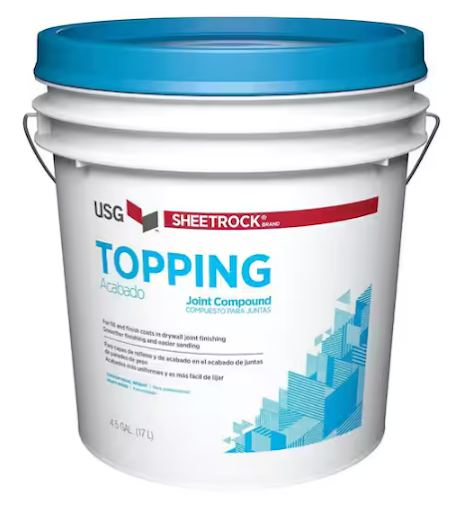
2. Topping Compound: The Smooth Finish You Need
This compound is used as the final coat, providing a smooth surface for painting. It sands more easily than taping compound and is formulated to offer a more polished finish with minimal shrinkage.
Pros:
- Provides a smooth, even finish
- Easy to sand
- Ideal for top coats
Cons:
- Not designed for embedding tape
- Less durable for heavy fills
Example product: USG Sheetrock® Topping Compound
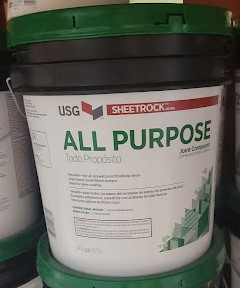
3. All-Purpose Compound: The Versatile Option
The all-purpose compound is a blend of taping and topping compounds. It can be used for all drywall tasks, including taping, filling, and finishing. This makes it one of the most popular types of compounds for both professionals and DIYers. It offers a balanced combination of adhesion, smoothness, and ease of use.
Pros:
- Suitable for all coats (taping, filling, finishing)
- Easy to use and sand
- Versatile for a variety of tasks
Cons:
- May require more coats than other options
- Not as fast-setting as specialized compounds
For more detailed tips on using all-purpose compound, read our article on choosing the right drywall compound.
Example product: USG Sheetrock® All-Purpose Compound
4. Lightweight Compound: For Easier Handling
For projects where weight is a concern, a lightweight compound is an excellent choice. It offers similar properties to all-purpose compound but is easier to handle due to its lighter weight. It’s ideal for smaller jobs, especially when you need to minimize fatigue.
Pros:
- Lighter weight, easier to handle
- Reduced shrinkage
- Ideal for DIYers and smaller projects
Cons:
- Slightly less durable for heavy fills
- May require more coats than heavier compounds
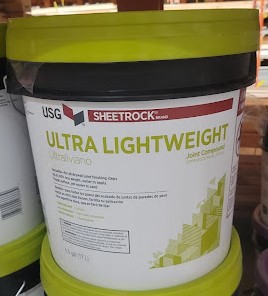
Example product: USG Sheetrock® UltraLightweight Joint Compound
5. Midweight Compound: The Best of Both Worlds
Midweight compound offers a balance between traditional and lightweight compounds. It provides the durability and strength of conventional compounds with the ease of use and smooth finish of lightweight options. This makes it ideal for contractors who need to combine strength with ease of application.
Pros:
- Balanced between lightweight and traditional compounds
- Good for general drywall applications
- Easier to sand than heavy compounds
Cons:
- Slightly more difficult to handle than ultra-lightweight compounds
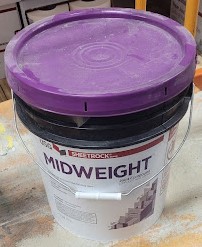
Example product: USG Sheetrock® Midweight Joint Compound
6. Plus 3® Compound: The Lightweight, Smooth Finish Solution
For a compound that offers the ease of a lightweight formula with the smoothness of a topping compound, USG Sheetrock® Plus 3® is a top choice. It provides the convenience of a single compound that performs as both a taping and topping compound, allowing for easier application and faster results.
Pros:
- 25% lighter than traditional compounds
- Requires fewer coats
- Sands easily for a smooth finish
Cons:
- Not as fast-setting as other compounds
Example product: USG Sheetrock® Plus 3® Joint Compound

7. Fire-Rated Compounds / Assemblies: Safety First for Code Compliance
Fire-rated compounds are specifically designed to enhance the fire-resistance of walls and ceilings. These compounds are typically used in combination with Type X drywall to meet fire code requirements.
Where required:
- Walls separating attached units (e.g., Philadelphia rowhouses)
- Walls around mechanical rooms, boiler rooms, or garages
- Floor-ceiling assemblies between living units
Pros:
- Provides fire-resistant protection
- Meets UL and ASTM fire-rating standards
- Can be used with standard taping and finishing tools
Cons:
- Slightly more expensive than standard compounds
- Requires proper installation with fire-rated drywall to achieve full rating
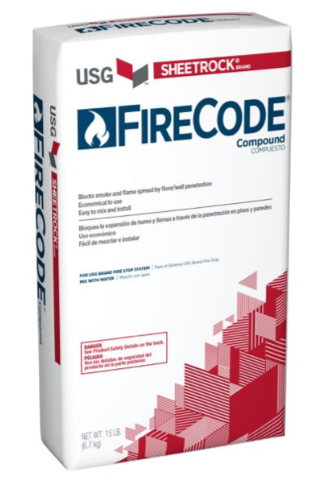
Example product: USG Sheetrock® Brand Firecode® Compound
8. Dust Control Compound: Keep Your Workspace Clean
For those working in homes or occupied spaces, a dust control compound is a must-have. This compound is designed to reduce the amount of airborne dust during sanding, making cleanup easier and reducing the mess in your work area. It’s a great option for those who are sensitive to dust or working in finished spaces.
Pros:
- Reduces airborne dust
- Easy to clean up
Ideal for occupied spaces
Cons:
- Slightly more expensive than standard compounds
- May not provide as smooth a finish as other compounds
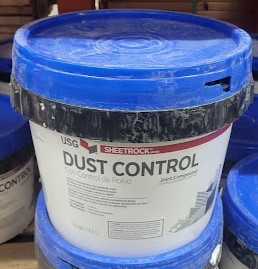
Example product: USG Sheetrock® Dust Control Compound
9. Setting-Type Compound: Fast Drying for Quick Turnarounds
Unlike ready-mixed compounds, setting-type compounds (commonly known as “hot mud”) use a chemical process to dry. They set up quickly (5 to 210 minutes, depending on the compound type), allowing you to complete your drywall work in record time. These compounds are ideal for repairs or areas that require quick turnaround.
Pros:
- Dries quickly (depending on the setting time)
- Low shrinkage
- Excellent for repairs and patching
Cons:
- Limited working time (once mixed, it must be used quickly)
- Harder to sand compared to ready-mixed compounds
Example product: USG Durabond® 90 Setting-Type Joint Compound
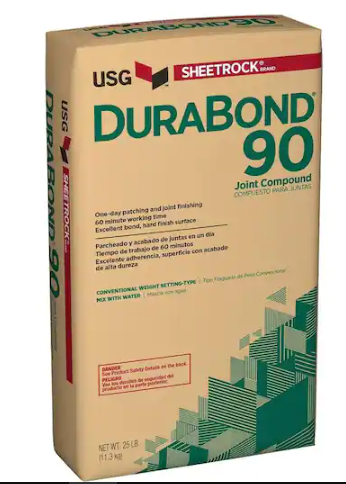

Types of Compounds & Comparison Overview
| Type / Name | Typical Use / Role | Key Properties / Strengths | Drawbacks / What to Watch Out |
| Taping Compound (or “tape coat”) | First layer embedding paper/fiber tape over joints & corners | Strong adhesion, good bond, moisture tolerance, less shrinkage on fills | Harder to sand; not ideal as final coat |
| Topping Compound | Final coat(s) — smoothing + finish before painting | Very smooth finish, easy sanding, low shrinkage | Less structural strength; not great for embedding tapes or heavy fill |
| All-Purpose Compound | All coats: taping, filling, finishing — a general “do-it-all” | Balanced between adhesion and smoothness, moderate shrinkage | Not as fast-setting as some |
| Lightweight / Ultra Lightweight All-Purpose | Same as all-purpose, but lighter for easier handling | Easier to work with, less shrinkage, easier sanding | Might be less durable in heavy fills |
| Midweight Compound | A middle ground between conventional and lightweight | Easier than conventional, stronger than ultra-light | Slightly more difficult than ultra-light to sand |
| Plus 3® Compound | Combines taping and topping in one product | all-purpose finish
Lighter, requires fewer coats, sands easily |
Not as fast-setting as setting-type compounds; slightly higher cost |
| Fire-Rated Compound | Walls or ceilings requiring fire-rated assemblies (with Type X drywall) | Helps meet fire-rating codes; compatible with standard finishing techniques | Standalone fire-rated compounds are rare; must pair with Type X drywall |
| Dust Control / Low Dust | For projects where dust is a concern (homes, occupied spaces) | Binds fine dust so less airborne, better cleanup | Slightly higher cost; may compromise ultimate smoothness a bit |
| Setting-Type (“Hot Mud”) Compound | Fast repair, heavy fills, cold/humid environments | Dries via chemical set (not air), fast turnaround, low shrinkage | Hard to sand if left too long; limited working time; more waste |
Recommended Joint Compounds by Area in a Typical Philadelphia Rowhouse
1. Shared / Party Walls
Shared walls between attached rowhouses, as well as walls around mechanical rooms, garages, and floor-ceiling assemblies, require fire protection to comply with Philadelphia building codes. In these areas, fire-rated compounds often used with Type X drywall are essential to slow fire spread. To improve sound isolation, incorporate soundproofing systems such as Green Glue or Sheetrock® Acoustical Sealant between drywall layers, since acoustic-specific joint compounds are not sold separately. Finish joints with topping or Plus 3® compound for a smooth, durable surface.
2. Bathrooms
Bathrooms are moisture-prone areas. While mold-resistant joint compounds are not commonly available, pairing all-purpose or lightweight compound with Mold Tough® panels or other moisture-resistant drywall provides a mold-resistant system. Use standard compounds for taping, finishing, and topping. The final surface can be smoothed with Plus 3® or topping compound for paint-ready results.
3. Kitchens
Kitchens may have occasional moisture exposure near sinks and countertops. Use all-purpose or lightweight compounds for joints, and topping or Plus 3® compounds for the final coat. For higher durability, Mold Tough® panels can be used if ventilation is limited.
4. Basements
Basements often face higher humidity and foot traffic. Use all-purpose or lightweight compounds for finishing joints, and midweight compounds for areas needing extra durability. Setting-type compounds are useful for fast repairs or patching. For moisture-prone walls, pairing with Mold Tough® panels.
5. Hallways and Staircases
These areas experience heavy use. Use midweight or all-purpose compounds for joints and corners, followed by a topping or Plus 3® compound for smooth finishing. Impact-resistant drywall systems like CertainTeed DensArmor Plus® or Extreme Impact Panels provide additional durability where walls may be subjected to knocks and scrapes, since standalone impact-resistant joint compounds are not sold.
6. Bedrooms and Living Rooms
For standard interior walls, all-purpose or lightweight compounds handle taping and finishing, with topping or Plus 3® compounds for the final coat. Acoustic isolation can be improved with resilient channels or soundproofing systems like Green Glue between drywall layers, as there are no dedicated acoustic joint compounds on the market.
7. Exterior / Soffits / Covered Porches
Exterior-facing walls or soffits in rowhouses are rarely finished with standard joint compound due to moisture exposure. If finishing protected exterior ceilings, use setting-type compounds (e.g., USG Easy Sand™) on seams. For exposed surfaces, rely on exterior gypsum ceiling boards combined with proper joint treatments, since standard compounds cannot withstand direct weather exposure.
Summary Table – Philadelphia Rowhouse Compound Guide
| Area | Recommended Compounds / Systems | Notes |
| Shared / Party Walls | Fire-rated, All-purpose, Setting-type, Plus 3®, soundproofing systems (Green Glue, Acoustical Sealant) | Fire separation required; optional noise reduction |
| Bathrooms | All-purpose / Lightweight + Mold Tough® Panels | Moisture protection; final coat with topping/Plus 3® |
| Kitchens | All-purpose / Lightweight | Optional Mold Tough® panels; finish with topping/Plus 3® |
| Basements | All-purpose / Lightweight / Midweight + Mold Tough® Panels | High durability, moisture-prone areas; setting-type for patching |
| Hallways / Staircases | Midweight / All-purpose + Topping / Plus 3®; Impact-resistant panels | High-traffic durability; no standalone impact compounds |
| Bedrooms / Living Rooms | All-purpose / Lightweight + Topping / Plus 3® | Standard finishing; optional acoustic improvements via channels/Green Glue |
| Media / Offices | All-purpose + Topping / Plus 3®; acoustic systems | Soundproofing via resilient channels / damping compound |
| Exterior / Soffits | Setting-type compounds; exterior gypsum boards | Only for protected exterior areas; not for exposed siding |
Conclusion
Choosing the right types of compounds is essential to the success of any drywall project. Whether you’re looking for fast drying, ease of sanding, or a smooth finish, there’s a compound for every need. By understanding the differences between taping, topping, all-purpose, lightweight, and setting-type compounds, you can ensure that your drywall installation or repair goes smoothly and efficiently.
Want to learn more about drywalling? Explore more of our expert guides on drywalling, repair, and construction tips on our Blog.
Contact us for a FREE Consultation if you need a renovation service in Philadelphia and South Jersey.
Planning a project in Philadelphia or South Jersey?
MatrixGC is a licensed Philadelphia general contractor (#43984). Learn about our permits and zoning, see Our general contracting, or get a free estimate. Call (215) 501-7566.


0 Comments