
When you’re a parent, thinking about protecting your little ones, you want every corner of your home to be as safe as possible. And yes, Child-Safe Window choices are a critical piece of that puzzle.
In this article, I want to talk through why window safety matters (with some alarming stats), how it shows up in Philly homes, and then dig deep into the many window types and protection devices families should know about.
I’ll speak from experience, having read widely and from talking with individuals who’ve done this work in older housing. I hope this reads like something a neighbor might say, “hey, here’s what we found works,” not like a robot lecture.
Window Hazards & Why “Child-Safe Window” Matters
If you search for “Window Falls children,” you’ll find it’s not some rare freak accident. It’s tragically common.
- According to a 2024 study at UC Davis, each year, around 8 children age 5 or under die, and about 3,300 are injured from falling out of windows in the U.S.
- Another report cites over 5,000 children fall from windows annually (with as many as 8 deaths) in the U.S.
- The National Safety Council (via SafeKids) notes “more than 3,300” children younger than 6 fall from windows every year.
- In pediatric injury research, “window falls in children” studies show that children under 5 are especially vulnerable, and many falls come from upper floors.
To put it simply, kids don’t need much leverage or reach to put themselves in danger when windows are open or inadequately secured. Screens are not sufficient protection (they’re not designed to stop a fall). Many sources warn explicitly: do not rely on screens to keep children safe. (King County)
So when you hear “Child-Safe Window,” know that it means more than a lock. It means thinking through how much a window can open, how a child might reach it, what the glass is made of, how quickly you can escape in a fire, and what safety devices are available to balance security and egress.
Window Safety in the Context of Philadelphia Homes
Philadelphia’s housing stock is older than many U.S. cities. Rowhomes, twin houses, and multi-story homes built in the early 20th century, sometimes with later renovations. That raises both challenges and opportunities when implementing Child-Safe Window solutions.
1. Historic or Legacy Windows
Many homes have older sash, double-hung, or single-hung windows with traditional frames. Sometimes the frames are warped or damaged, making it tricky to retrofit modern safety gadgets.
2. Multi-Level Homes / Upper Floors
Because many Philadelphia houses are two- or three-story rowhomes, the second or third floor windows pose a serious fall risk. A child falling from a second or third-floor window onto concrete or brick can suffer severe injury.
3. Landlord/Tenant Dynamics
Many homes are rented; landlords may resist expensive window upgrades. But they may be open to “device” upgrades (guards, stops) to reduce liability.
4. Regulation, Permits, and Local Funding
Philadelphia offers some home improvement and repair programs (e.g., Restore Repair Renew, PHDC’s home repair/improvement programs) for low-interest loans or grants.
But I haven’t found one that specifically mandates child window safety devices. You’ll need to coordinate with local code, permit offices, or check neighborhood historic regulations.
5. Balancing Safety Vs Fire Egress/Escape
In a fire or emergency, windows often serve as secondary egress points. So devices must allow for quick escape when needed. Many safety devices (window guards, opening control devices) are designed to comply with ASTM F2090 standard for “Window Fall Prevention Devices with Emergency Escape (Egress) Release Mechanisms.”
That said, many families in Philly have successfully upgraded windows or installed safety devices. Once you accept that older windows may need custom work, you can mix “device retrofit + partial window replacement + safety glass” to get to a child-safe setup.
Codes & Standards You Should Know (Philadelphia + National Baselines)
Codes evolve, but these are the key touchstones affecting Child-Safe Window planning in Philly:
1. Window Fall Protection — IRC R312.2
The IRC requires window fall protection where the sill height is greater than a specified height above grade and the operable opening is large enough to pose a risk. Compliance options include Window Opening Control Devices (WOCDs) or guards that meet ASTM F2090. (Check Philadelphia code requirements here.)
2. Egress (Emergency Escape & Rescue Openings) — IRC R310
Sleeping rooms (and some basements) need a compliant egress window or door. Standards define the clear opening area, height, width, and sill height (commonly max 44″ above finished floor), among other details, including allowances for existing windows. This is crucial: any Child-Safe Window device in a bedroom must NOT block egress when properly released. (Check Philadelphia code requirements here.)
3. Safety Glazing — CPSC 16 CFR Part 1201 & ANSI Z97.1
Certain hazardous locations (near doors, stair landings, large panels close to the floor, etc.) require safety glazing (tempered or laminated) tested to federal CPSC 16 CFR 1201 or ANSI Z97.1. Using the right glass doesn’t stop a fall, but it reduces laceration risk if the glass breaks.
Bottom line: pick Child-Safe Window devices that comply with ASTM F2090 (or applicable standards), and make sure any bedroom egress window still opens to code when the device is properly released.
Meet the National Association for Child Window Safety (NACWS)
If you’re hearing about them for the first time, the National Association for Child Window Safety is a nonprofit focused on preventing child window falls through education and advocacy. They share practical guidance families can implement quickly and provide a focal point for awareness campaigns.
What NACWS does (in plain terms):
- Raises awareness around child-safe window practices and the right safety devices.
- Encourages proper installation (and adult-operable emergency release).
- Helps parents, landlords, and communities find clear, actionable info (and a place to get involved/donate).
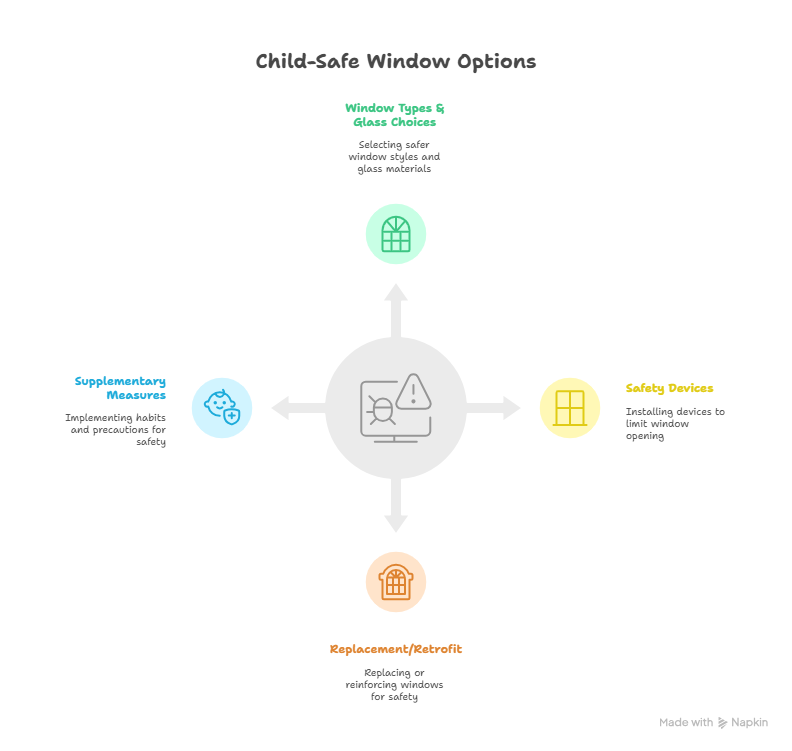
Categorizing Child-Safe Window Options
To stay organized, let’s break things into categories:
- Window Types & Glass Choices
- Safety Devices / Control Devices
- Window + Frame Replacement / Retrofit
- Supplementary Measures & Habits
I’ll go through each, pros & cons, and what works especially well in older homes like Philly’s.
1. Window Types & Glass Choices
One way to make a window more child-safe is by selecting a safer style or safer glass material from the start (or when replacing windows).
a. Double-hung / Single-hung / Sash windows (with tilt-in design)
These are common in older homes. The advantage: modern double-hung windows often allow opening from the top sash downward, which means children can’t reach the bottom opening if only the top sash is opened.
Many newer replacement models also allow “tilt-in” cleaning, which helps maintenance without opening dangerously. However, by themselves, they don’t fully guarantee “Child-Safe Window” behavior; you need safety devices too.
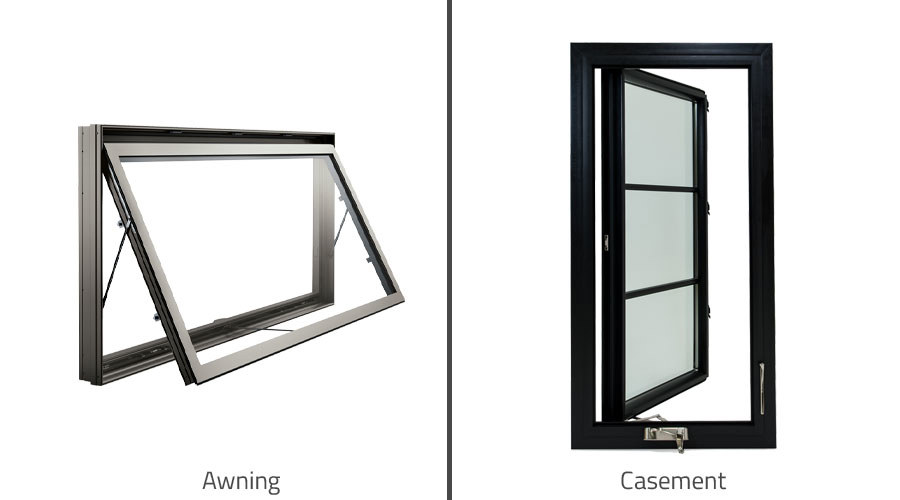
b. Casement or Awning windows
These open outward with a crank. Because kids can’t easily crank them open from inside (if they’re high enough or if the crank is out of reach), they offer built-in resistance. Some people prefer them in “kids’ rooms” for that reason.
Downside: if a child can reach the crank mechanism, it might be manipulated, and if the window isn’t properly secured, the whole sash can swing open.
c. Hopper windows (top-hinged, open inward downward)
Less common for full rooms, more often in basements or bathrooms. Their opening direction limits how far a child could fall; the sash tilts inward from the top. But their use in bedrooms is limited.
d. Fixed windows / non-operable windows
These don’t open at all, which is the ultimate in preventing falls. But they can’t serve as escape windows. In some rooms, you might designate one window as non-operable (child-safe) but leave another for egress in case of fire, as code allows.

e. Glass choices: Tempered glass & Laminated glass / Safety glass
One overlooked part of a child-safe window is what happens if the glass breaks. Safer glass reduces the risk of severe cuts.
- Tempered glass: treated so that when it breaks, it shatters into small, relatively blunt pebble-like fragments rather than large shards.
- Laminated glass: two or more glass panes bonded with a plastic interlayer (often polyvinyl butyral, PVB). If broken, the glass holds together and doesn’t rupture completely.
- In Philadelphia / local codes, certain window locations (adjacent to doors, bottom stairs, guard rails) require safety glass by code.
For more information, refer to this article: Safety Window Glass for Your Philadelphia Home: A Complete Guide
Using tempered or laminated glass doesn’t by itself prevent a fall, but it mitigates injury if a child leans on or breaks the glass.
2. Safety Devices / Control Devices
This is the toolkit side: devices you can install on existing windows to make them safer, ideally in a reversible or semi-reversible fashion. These often get you the most “bang for buck.”
a. Window Opening Control Devices (WOCDs) / Window Opening Limiters / Window Stops
These are mechanical devices that limit how far a window can open (for example, to 3 or 4 inches). They are often designed to be compliant with ASTM F2090 standards, which require a child-resistant release for emergency escape.
Pros:
- Inexpensive relative to full replacement
- Can be retrofitted on many types of windows
- Allow ventilation, but prevent wide-open windows
- Some models disengage easily to allow full opening if needed
Cons:
- If installed improperly, the window may break or bypass the limiter
- The release mechanism must be both secure against child manipulation and easy for adult escape
- Some argue (fire safety advocates) that such devices might slow egress, but properly designed ones should not impede emergency escape.
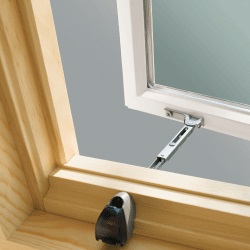
b. Window Guards / Grilles
These are bars or mesh grilles over the window opening, typically installed across the interior side of the window sash. They act like a guardrail to prevent a child from falling out.
- Many window guard designs include a quick-release / emergency release so adults or occupants can remove them in case of fire/escape.
- The spacing of the bars is critical: they must be close enough so a child cannot slip through (often less than 4 inches).
- Some municipal programs even distribute window guards (though I did not find one in Philadelphia specifically); e.g. Boston had a window guard program. (Boston.gov)
Pros:
- Very strong barrier
- Good for upper-floor windows or windows with wide openings
- Durable
Cons:
- If the guard is permanent and doesn’t have a quick-release, it could hinder emergency escape
- Aesthetic concern (bars may not align with some architectural styles)
- More expensive and more invasive than simple stops
c. Safety Screens
Unlike insect screens, safety screens are reinforced mesh or film-backed screens designed to resist impact or tension, so that leaning or pushing won’t dislodge them.
- These can help slow or partially prevent a fall, but are not usually sufficient on their own.
- They are supplementary, often used in combination with WOCDs or guards.
- Some safety films (applied to existing glass) also help; they reduce shattering and can reduce injury risk from broken glass.
d. Child-Resistant (Dual-Action) Window Latches / Locks
These are locks where two actions or steps are required to open. A child cannot simply unlatch with one move. Some windows come with these built in; others let you retrofit a secondary latch.
e. Smart / Sensor-based window locks/alarms
Emerging products include sensors or alarms that alert when a window is opened beyond a threshold, or that lock automatically. Some brands integrate with home automation systems. While these don’t prevent the opening mechanically, they can give an early warning.
3. Window + Frame Replacement/Retrofit
Sometimes devices alone aren’t enough; the window or frame is too warped, cracked, or simply old. In those cases, you may want to replace or substantially retrofit the window itself, choosing safer designs from the ground up.
a. Full window replacement with child-safe models
You might replace a full window with one that includes WOCD built in, a safer sash design, stronger frames, tilt-in sashes, and safety glass. Many window manufacturers now market “child-safe” or “child-resistant” options.
b. Partial retrofit/sash replacement
If the frame is okay but the sash (the moving part) is damaged or does not allow safer opening, you might replace only the sash with a modern one. Then you can install control devices more reliably.
c. Reinforcing existing frames
In older homes, frames may be rotted or loose. Reinforcing with metal channels, new hardware, or new tracks can make it safer to attach guards or limiters. This is structural work, but often necessary for child-safe window reliability.
d. Secondary glazing/storm windows
Adding a second interior pane (storm window) can serve as a buffer, preventing a child from pushing the primary pane outward too far, or giving additional structural support. Not a replacement for safety devices, but supplemental.
4. Supplementary Measures & Habits
Even the best child-safe window device won’t help if you leave a window wide open or put a dresser under it and let kids climb. So a comprehensive approach includes:
- Furniture placement: Keep beds, chairs, dressers, and anything climbable away from windows.
- Window-opening practices: Only open windows that are out of children’s reach, or use top-down opening when available. Many experts suggest opening from the top only.
- Locking windows when not in use
- Supervision & education: Teach children that windows are dangerous, and don’t let them play near open windows
- Working smoke alarms: Because in a fire, you might need windows for egress, but you want the alarms to alert you before you’re trapped.
- Cordless window coverings: Avoid blinds or drapes with cords (strangulation risk). Use cordless or interior-encased blinds.
Matrix Suggestions: Choosing What’s Right for You
Below is a decision framework to help families in Philadelphia (or similar older-home areas) pick the right child-safe window combination.
| Scenario / Priority | Best Option(s) | Notes / Caveats |
| You just want a low-cost retrofit on existing windows | WOCD / window stop + child-resistant latch | Be sure it is ASTM F2090-compliant; hire a professional for tricky windows |
| You have a second or third-floor bedroom window with a wide sash | Window guard with quick release + WOCD | The guard gives barrier protection, WOCD ensures ventilation + emergency release |
| The window frame is old/warped/cracked | Sash replacement or full window replacement | Retrofitting devices into weak frames is risky |
| You want safer glass for breakage risks | Tempered or laminated glass in the panes | Doesn’t prevent falls but reduces injury from shattered glass |
| You want smart alerts or extra warnings | Sensor-based locks or alarms | Use as a supplement, not a replacement for mechanical safety |
| You want to upgrade all windows in the home | Install new windows with built-in WOCD, safer sash design, safety glass, and smart locks | More upfront cost, but a cleaner look and long-term value |
| You’re renting and can’t change windows | Use removable WOCDs or window guards with permission | Make sure devices are easily removable and don’t damage frames |
Practical, Room-by-Room Plan (Philly Edition)
- Nurseries & kids’ bedrooms
- Install WOCDs that meet ASTM F2090; verify adult egress works as designed.
- Add quick-release window guards if the sash is big or the sill is low.
- Use top-sash opening for ventilation on double-hung models.
- Confirm the window still satisfies IRC R310 egress dimensions once the device is released.
- Install WOCDs that meet ASTM F2090; verify adult egress works as designed.
- Living rooms over sidewalks or alleys
- If glass is large and low, upgrade to tempered or laminated safety glazing (per hazardous-location rules).
- Consider reinforced safety screens plus WOCDs so you can keep a breeze without a wide opening.
- If glass is large and low, upgrade to tempered or laminated safety glazing (per hazardous-location rules).
- Basements
- If used as a sleeping area, confirm egress window and well comply with IRC. If not sleeping space, hoppers with limited opening plus secondary locks can help.
- Stair landings with windows
- These often trigger safety glazing requirements; a child can tumble into glass at a landing. Upgrade appropriately and consider guards if the window opens wide.
- Historic façades
- If replacement changes the exterior, expect review. Often you can achieve a child-safe window using interior WOCDs and guards that don’t alter the façade, or you can commission historically appropriate sash with modern hardware.
How 203(k) can help with Child-Safe Window projects
If you’re in a home you own (or buying a home), the FHA 203(k) allows you to finance repairs, improvements, and renovations including window upgrades into your mortgage.
Two flavors matter:
- Limited (or “Streamline”) 203(k): Good for smaller, non-structural improvements (like replacing windows, adding window safety devices). It permits up to $75,000 for repair or renovation work (in many cases).
- Standard 203(k): For more structural or major rehab work, if, for example, window framing or wall work is involved. Requires a consultant.
So materially, you could buy (or refinance) your Philadelphia home and roll the cost of child-safe window replacements, upgraded glass, new hardware, guards, etc., into your loan rather than paying out-of-pocket. That’s a powerful way to make safety upgrades more affordable.
Just be sure to use an FHA-approved 203(k) lender, get all required permits, and follow the 203(k) consultant’s required inspections and draw schedules.
Also, check local Philadelphia programs (PHDC, Restore Repair Renew, etc.), as sometimes you can stack local grants or low-interest loans with the 203(k) approach.
Conclusion
Let’s be real: making a Child-Safe Window plan is one of those “do it once, sleep better every night” upgrades, especially in multi-story Philly homes. You’re not just sticking a latch on and calling it a day. You’re blending:
- a code-aware egress plan (IRC R310),
- fall protection that actually works (R312.2 + ASTM F2090 devices),
- the right glass in the right places (CPSC/ANSI safety glazing), and
- a few daily habits (top-sash venting, no climbables) that cost nothing and matter a lot.
If your frames are old, build the right foundation (repair/replace), then add WOCDs and, where needed, quick-release guards. If you’re upgrading glass, consider laminated or tempered. And if budget is the blocker, look at 203(k) to roll this work into a single, manageable finance plan.
Contact us today for a FREE Consultation!
Planning a project in Philadelphia or South Jersey?
MatrixGC is a licensed Philadelphia general contractor (#43984). Learn about our whole-home renovations, see Philadelphia general contractor, or get a free estimate. Call (215) 501-7566.




![Comprehensive Guide to Skylight Installation on a Roof Deck [2026 Guide]](https://matrixgc.com/wp-content/uploads/2025/06/Skylight-Installation-400x250.jpg)
0 Comments