In recent years, prefab homes in Philadelphia have become one of the most talked-about trends in residential construction. Once seen as a “budget alternative” to traditional homes, modern prefabricated housing now combines architectural innovation, energy efficiency, and affordability.
In this in-depth guide, we’ll explore the key differences between offsite (prefab) and onsite (stick-built) homes, unpack the various types of prefab construction, discuss financing and regulatory considerations, and take a close look at what makes prefab homes particularly relevant and valuable in Philadelphia’s housing market. Let’s get started!
Offsite vs. Onsite Built Homes: Understanding the Core Difference
One of the most fundamental decisions you’ll make when building a home is whether to build it onsite (traditional construction) or offsite (prefabricated).
Builders construct onsite-built homes, or stick-built homes, piece by piece directly on the property. In contrast, they build offsite homes in a factory-controlled environment and then transport them to the site for assembly.
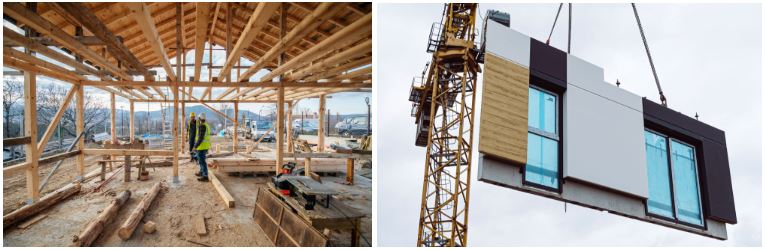
Let’s look at some of the most notable differences between the two.
1. Speed and Efficiency
One can build prefab (offsite) homes up to 50–70% faster than traditional homes. For instance, a 3,000 sq. ft. modular home can be completed in a factory in just 6 days. Once delivered and set on its foundation, finishing touches like plumbing, HVAC, and electrical can be completed in weeks, not months.
Traditional construction, on the other hand, is subject to weather delays, scheduling conflicts, and unpredictable material shortages, which can stretch build times significantly.
2. Price Control and Budget Predictability
Prefab home manufacturers work under strict cost control, as materials and labor costs are fixed from the start. This eliminates the risk of cost overruns common in stick-built projects.
In traditional construction, fluctuating material prices and labor availability can drive up costs mid-project, forcing builders to renegotiate or issue change orders.
3. Material Quality and Strength
Prefab homes can withstand transport and crane lifting, meaning they are structurally stronger than most site-built homes. For instance, builders often double up 2×10 perimeter bands and use urethane-based foam adhesive between drywall seams and studs to ensure straight, durable walls.
Traditional homes, while sturdy, are not built with the same reinforced structure required for transport.
4. Weather Resistance and Worksite Cleanliness
Because prefab construction takes place indoors, materials never get wet. This prevents issues like mold or rot.
Job sites remain clean and organized since all components arrive ready to assemble, and material theft (a surprisingly common issue in traditional builds) is virtually eliminated.
5. Code Compliance
Modular homes follow the same IBC (International Building Code) or IRC (International Residential Code) standards as traditional homes. The only difference is that builders assemble them in a factory instead of on-site.
That means when it’s time for inspection, a modular home passes with the same building standards as any stick-built property.
Types of Prefab Homes
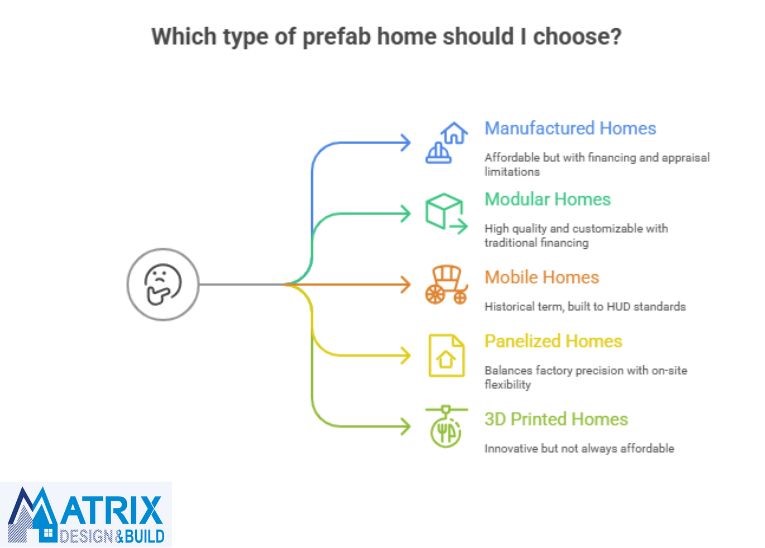
The term “prefab” (short for prefabricated) covers several categories of homes built offsite. Each has its own construction method, code requirements, and financing rules.
1. Manufactured Homes
Manufactured homes are built entirely in a factory under the federal code regulated by the U.S. Department of Housing and Urban Development (HUD).
Builders construct them on a permanent steel chassis and transport them to the site, where they are installed on either a permanent or non-permanent foundation. To find more information about HUD requirements for manufactured homes’ foundations, check out 4930.3G – Permanent Foundations Guide for Manufactured Housing. These homes are often the most affordable type of prefab housing, but have limitations in financing and appraisal.
Key details:
- Built to HUD code (not IRC)
- Can be single-, double-, or triple-wide
- May or may not be installed on a permanent foundation
- Typically appraised lower than modular homes
Financing Options:
If you’re buying a lot and a manufactured home, the FHA Title I Manufactured Home Loan Program is ideal.
If you’re purchasing an existing manufactured home that needs renovation, the FHA 203(k) Loan may apply.
Learn more about that here: 203(k) Loan for Manufactured Homes
You can find important information about the PA-manufactured housing program and the installation of new and relocated manufactured homes at this link.
2. Modular Homes
Modular homes set the gold standard for modern prefab construction. Builders create these homes in factory-made modules and assemble them on a permanent foundation at the site.
Unlike manufactured homes, modular homes follow local building codes (IRC/IBC), making them eligible for traditional 30-year mortgages, as well as FHA, VA, and RD loans. Appraisers also value them the same as stick-built homes.
Advantages of Modular Homes:
- Built stronger to endure transport
- High energy efficiency due to tight construction
- Fully customizable designs
- Shorter construction time
- Can be built “on-frame” or “off-frame”
They also support open floor plans; large rooms (like 30 ft. wide living areas) can be achieved by joining modules together and finishing the seams on-site.
3. Mobile Homes
Before 1976, factory-built homes were called mobile homes. After HUD introduced stricter building codes, they became manufactured homes. The main difference is historical, but all mobile homes are still built to HUD standards.
4. Panelized Homes
Panelized construction lies between modular and traditional methods.
Walls, floors, and roofs are built in a factory, then shipped flat to the site and assembled like a puzzle.
This method still requires some on-site labor, including plumbing, wiring, and interior finishing. However, it significantly reduces the total build time and waste compared to fully onsite construction.
Panelized construction is often used for custom builds where clients want the speed and precision of factory manufacturing but still prefer some flexibility during assembly.
5. 3D Printed Homes
3D printing is the newest innovation in prefab construction. They build these homes by robotic printers that layer concrete or composite materials to form the walls.
While it promises speed and sustainability, it’s still an emerging technology, and current 3D printed homes are not always as affordable as advertised. For example, some 3D printed homes in California sell at premium prices despite claims of being “affordable.”
Now, let’s see the differences between the two most common types of prefab homes in Philadelphia at a glance:
Comparing Modular vs. Manufactured Construction
| Feature | Modular Homes | Manufactured Homes |
| Building Code | IRC/IBC (local building codes) | HUD (federal code) |
| Foundation | Permanent | Nonpermanent |
| Financing | FHA, VA, RD, Conventional | FHA Title I, limited options |
| Appraisal | Same as site-built | Lower valuation |
| Customization | High | Limited |
| Durability | Very strong | Moderate |
| Placement | Residential zones | May be restricted in cities |
Thinking about adding space to your home?
MatrixGC designs and builds second-story, rear, third-floor and ADU additions in Philadelphia and South Jersey. Free estimate and free design consultation, permits handled, 203(k) and HomeStyle loans welcome. Buying a fixer-upper? See our 203(k) renovation services.
Prefab Homes in Philadelphia: A Market on the Rise
Philadelphia, known for its rich architectural heritage and diverse neighborhoods, is now embracing prefab homes as a forward-thinking solution to its housing challenges.
With rising land prices, labor shortages, and an increasing demand for sustainable housing, prefab homes in Philadelphia offer an efficient and environmentally conscious way to meet housing needs, from first-time homebuyers to urban developers.
Why Prefab Homes Are Gaining Popularity in Philadelphia
- Urban Infill Opportunities: Vacant lots across neighborhoods like Fishtown, Brewerytown, and Point Breeze make ideal locations for modular infill housing. Builders can deliver pre-constructed modules and assemble them quickly, minimizing neighborhood disruption.
- Energy Efficiency: Philadelphia’s climate demands well-insulated, efficient homes. Modular and panelized homes provide tight construction envelopes, often exceeding local energy codes.
- Sustainability Goals: The city’s sustainability initiatives align perfectly with prefab construction. Offsite building reduces waste, cuts emissions, and optimizes material use.
- Affordability and Speed: For buyers seeking affordable new construction, they can complete prefab homes in Philadelphia in a fraction of the time at a lower cost, a major advantage in a city where construction delays are common.
Financing Prefab Homes in Philadelphia
Financing options for prefab homes in Philadelphia depend on the home type:
- Modular homes: Qualify for standard mortgage programs (FHA, VA, Conventional).
- Manufactured homes: May require specialized loans like FHA Title I or 203(k).
- Panelized homes: Typically financed like stick-built homes once the foundation is permanent.
Conclusion
Prefab homes in Philadelphia provide a balanced mix of affordability, design flexibility, and sustainability. Whether you’re a developer looking to streamline multi-unit construction or a homeowner seeking a custom modular build, prefab housing offers a practical path to new homeownership without sacrificing quality or style.
Philadelphia’s architectural fabric has always evolved, from colonial rowhomes to 21st-century modular builds and prefab homes represent the next chapter in that story.
Do you have any questions? Let us know in the comments below!
Planning a project in Philadelphia or South Jersey?
MatrixGC is a licensed Philadelphia general contractor (#43984). Learn about our home additions, see Vanilla box construction, or get a free estimate. Call (215) 501-7566.



0 Comments