
Are you thinking about a Philadelphia 3rd floor addition? Whether you’re a homeowner, developer, or contractor, adding a third story to your row house can be a smart way to gain extra space and boost property value. But this kind of project involves more than just design and construction; it requires deep knowledge of city zoning laws, permits, and structural conditions.
In this detailed guide, we walk you through 10 essential things to know before you start your 3rd-floor addition in Philly. Let’s get started!
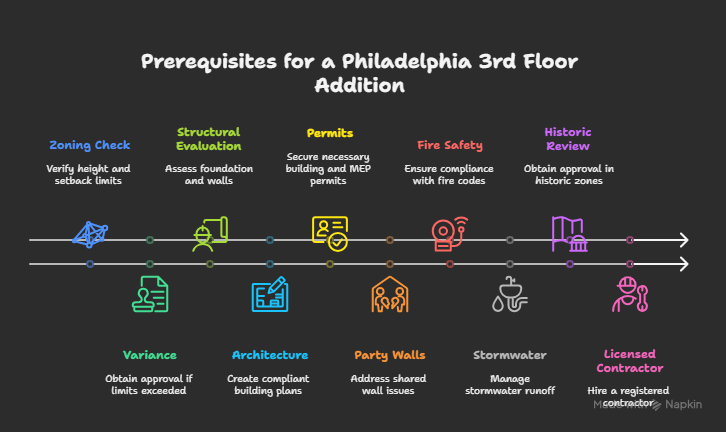
1. Zoning and Use Eligibility
Before designing or building anything, you need to check if zoning allows a 3rd floor. Visit https://atlas.phila.gov, enter your address, and review your zoning designation (e.g., RSA-5, RM-1, CMX-2).
RSA-5 is the most common zoning designation for Philadelphia row homes. It permits single-family residential use by right but has strict dimensional requirements that affect whether a 3rd-floor addition is permitted without a variance.
Height Limitations
Most Philadelphia row homes are zoned RSA-5, which allows a maximum building height of 38 ft by right. If your proposed addition exceeds this, you’ll need a zoning variance. Height is measured from the average grade to the top of the roof (excluding parapets or rooftop access if under the threshold).
Floor Area Ratio (FAR)
RSA-5 doesn’t have a FAR limit, but other districts like RM-1 and RM-2 do. In RSA-5, you’re limited by physical constraints such as setbacks, open space, and height.
Open Area Requirements
RSA-5 mandates at least 25% of your lot area remain as open space. On corner lots, the maximum occupied area is 80%, translating to a minimum open area of 20%. If your lot is under 45 ft deep, you may be exempt from this requirement.
Rear Yard Setback
You must maintain at least a 9-foot rear yard. Building into this space, especially at full height, will require a variance.
Front Setback and Height in Context
Generally, there’s no required front setback in RSA-5, but if both neighboring properties are two stories tall, your third floor may need to be set back 8 feet from the front facade to preserve the streetscape.
Side Yard Requirements
Row homes with shared party walls typically don’t need side yards. However, corner lots, semi-detached, or detached buildings must maintain side yards of at least 5 feet wide.
Number of Stories
The code does not restrict the number of stories, only the total building height (38 ft max), rear yard, and open area.
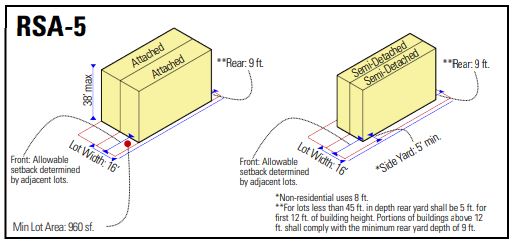
If your proposed Philadelphia 3rd floor addition exceeds any of these, you’ll need a zoning variance. For more information about zoning districts, refer to the Philadelphia Zoning Quick Guide.
2. Zoning Variance (if required)
When Is It Needed?
If your 3rd floor addition is:
- Over 38 feet high in an RSA-5 zone,
- Violating rear or side yard setbacks,
- Creating a use not permitted by right (e.g., turning a single-family home into a duplex),
Process:
- Zoning Refusal: Submit a zoning permit application. If it violates code, you’ll receive a Notice of Refusal.
- Community Meeting: You’re required to present your project to the local Registered Community Organization (RCO).
- ZBA Hearing: Attend a hearing with the Zoning Board of Adjustment.
- Approval or Denial: The ZBA will grant or deny the variance based on hardship, context, and public input.
This can take 2–4 months, depending on complexity.
3. Engineer’s Structural Evaluation
A rowhouse’s existing foundation and framing (usually from the 1900s–1950s) may not be designed to handle the weight of a 3rd floor. You need to verify this before designing anything. At Matrix Construction, we can help you figure out if the existing conditions of your house can accommodate a Philadelphia 3rd floor addition, or you need to make improvements.
A Licensed Structural Engineer Will:
- Inspect foundation walls, footings, and piers to confirm if they can carry extra load
- Evaluate masonry bearing walls and determine if they need reinforcement (e.g., steel beams, LVLs)
- Recommend whether you need:
- New footings or underpinning
- Reinforced floor joists
- Steel columns or lintels
- Shear wall modifications
Without this, your permit may be rejected during plan review, or worse, your structure may be unsafe.
4. Architectural Drawings
A critical part of the 3rd floor addition process is preparing architectural drawings. Philadelphia requires construction documents sealed by a licensed architect.
These include:
- Site Plan: Showing property lines, building footprint, and setbacks
- Floor Plans: Existing and proposed layouts
- Elevations: Front, side, and rear elevations showing height
- Structural Framing Plan
- Fire Safety Details: Fire-rated walls, egress windows, smoke detectors
- Section Drawings: Cut-through views showing roof slope, stairs, insulation, etc.
All drawings must comply with the 2018 Philadelphia Residential Code.
5. Permit Requirements
You need multiple permits through Philadelphia’s eCLIPSE system:
- Zoning Permit (if not already granted by right)
- Building Permit (required for any structural or layout change)
- Electrical Permit (new lighting, subpanel, etc.)
- Plumbing Permit (if adding bathroom or laundry)
- Mechanical Permit (HVAC work for 3rd floor)
Submissions Must Include:
- Construction drawings
- Engineering reports (if needed)
- Contractor license and insurance
- Owner’s approval (if you’re a contractor or developer)
Permit review usually takes 15–30 business days.
6. Neighbor Considerations & Shared Walls
Row homes often share party walls with neighbors. During construction:
- You cannot damage or build onto your neighbor’s wall without permission.
- Roof drainage must not flow onto neighbor properties
- Windows cannot be placed on a wall within 3 feet of a property line
- If your addition involves parapet walls or alleyways, you will need additional documents.
Since March 22, 2023, L&I has made it mandatory to provide certain documents for any renovation or construction work that impacts adjacent properties. These documents include:
- A pre-construction survey, where the engineer physically inspects the property and looks into associated records.
- A monitoring plan to ensure that the proposed activities do not have a negative impact on the building’s structural integrity.
- A written notification that informs the owners of neighboring properties about upcoming construction or demolition activities.
- You’ll also need to follow fire separation requirements between homes.
These issues can delay or block permits if not resolved early.
7. Fire Code and Egress Compliance
A Philadelphia 3rd floor addition triggers additional fire safety rules:
- Smoke Detectors: Must be hardwired and interconnected across all floors. You’ll likely need to upgrade smoke alarms in the entire home, not just the 3rd floor, especially if you’re doing major interior work.
- Egress from the 3rd Floor: If you’re building a third-floor addition intended for people to live in or use regularly, the code requires two ways to safely exit the building to the ground level. These must be:
- On opposite ends/sides of the structure.
- Either exterior stairs or a fire escape.
- Built from metal or fire-retardant / pressure-treated wood.
- Each exit point (door or window) must have a landing at least 3 feet wide with railings.
- Egress Windows: Required in every bedroom. Must meet minimum 5.7 sq ft openable area, 24″ clear height, 20″ clear width, and must open easily from the inside; no tools, keys, or codes.
- Fire-Rated Construction: If your addition’s walls are within 5 feet of a neighbor’s property line:
- Those walls must be built to a 1-hour fire rating
- Windows/openings may be restricted or not allowed
- Overhangs (like eaves) within 2 feet of the line need to be fire-protected underneath
- Sprinkler System: Not required unless converting to multifamily, increasing occupant load, or per special review.
These will be checked in the plan review and inspections. For more information about fire safety requirements, refer to the 2018 Philadelphia Fire Code and the 2018 Philadelphia Residential Code.
8. Stormwater Management Compliance
If your addition increases the roof or impermeable surface, the Philadelphia Water Department may:
- Require a stormwater management plan
- Request the use of green roofs, drainage channels, or detention systems
Usually, for residential row homes, this isn’t a major issue unless the lot is already overbuilt or you’re adding decks or patios.
9. Historic District Review (if applicable)
If your property is located in a designated historic district (like Society Hill, Old City, etc.), you must:
- Submit drawings to the Philadelphia Historical Commission
- Avoid visible changes to façade, roofline, cornices, or windows
- Get approval before any exterior alterations
Failing to do this can result in legal action and stop-work orders.
Use https://www.phila.gov/historical to check if your home is in a protected district.
10. Licensed Contractor Requirement
To perform the work legally in Philadelphia:
- The contractor must be licensed with the L&I (License and Inspections)
- They must carry:
- General liability insurance
- Workers’ comp insurance
- Tax Compliance (city business income & receipts tax must be up to date)
- The contractor license must be listed on permit applications
Hiring an unlicensed contractor for your Philadelphia 3rd floor addition will invalidate your permit and cause project delays or fines.
✅ Summary Table
| Step | Requirement | Key Notes |
| Zoning Check | Allowed height, setbacks | Use atlas.phila.gov |
| Variance | If exceeding limits | Requires ZBA approval |
| Structural Evaluation | By licensed engineer | Checks foundation/walls |
| Architecture | Full sealed plans | Must meet IRC 2018 |
| Permits | Zoning + Building + MEP | Use eCLIPSE portal |
| Party Walls | Shared wall issues | Requires access agreements |
| Fire Safety | Smoke, egress, rating | Must comply with IRC & PBC |
| Stormwater | May apply | Rare in row homes unless overbuilt |
| Historic Review | If in protected zone | Approval required |
| Licensed Contractor | Must be registered | Insurance & tax compliance |
Conclusion
Thinking of moving forward with your Philadelphia 3rd floor addition? We can help you review your zoning, draft a custom checklist, or show you a real permit package for RSA-5 row homes.
Reach out today for professional guidance and hands-on experience from local experts who know the Philadelphia permitting process inside and out. Contact us for a FREE Consultation.







0 Comments