
Let’s paint the picture: It’s July in Philly, the humidity is high, and the sun is brutal. Inside your classic South Philly rowhome, you’ve got window AC units rattling away like a SEPTA train, and still, you’re sweating. Sound familiar?
Now imagine stepping into a cool, whisper-quiet room. No bulky boxes in the windows, no roaring fans, just perfect comfort.
That’s what ductless mini splits for Philadelphia row homes promise and deliver.
Let’s dive into why this HVAC technology is not just a good fit, but the perfect solution for your Philly rowhome!
Why South Philly Homes Don’t Have Central Air
Ever wondered why so many homes in South Philadelphia rely on noisy window AC units?
Most of these row homes date back to the early 20th century. At the time, central air conditioning wasn’t even a concept, let alone ductwork. These homes were built narrow and tall, often with radiators and boilers for heat. This layout left little space for installing ductwork later on.
Even today, the backyards are tight. There’s barely room for a barbecue, let alone a big central AC condenser.
Window units became the norm. But they’re not ideal, are they? They’re loud, block your windows, are energy hogs, and let’s be honest, they don’t cool evenly.
Sound about right?
That’s where ductless mini splits for Philadelphia row homes change the game.
What Is a Ductless Mini Split and How Does It Work?
A ductless mini split is a type of HVAC system that heats and cools your home without needing any ductwork. It’s composed of two main parts:
- An outdoor unit (condenser)
- One or more indoor air handlers (evaporators)
These parts are connected by small refrigerant lines. The outdoor unit does all the heavy lifting, while the indoor units blow cool (or warm) air directly into your room.
Here’s why it works so well in tight Philly homes:
- No ducts needed.
- Flexible installation: wall-mounted, floor-mounted, or even ceiling-recessed units.
- Super quiet: both indoor and outdoor units are whisper-quiet compared to traditional AC systems.
That’s a huge win in a neighborhood where space is at a premium and peace and quiet are golden.
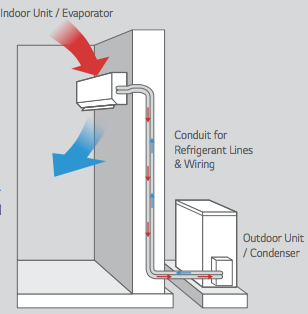
Figure 1
Mini-Split HVAC Systems vs Traditional Heating Systems
So, how does a ductless mini-split compare to old-school systems like gas furnaces or boiler/radiator combos?
Table 1: Ductless Mini-Split vs. Traditional HVAC (Furnace + AC)
| Feature | Ductless Mini-Split | Traditional HVAC (Furnace + AC) |
| Ductwork Needed | No | Yes |
| Energy Efficiency | Very High | Moderate |
| Installation Time | 1-2 Days | Several Weeks |
| Cooling & Heating | Both | Separate Systems Often |
| Noise Levels | Very Quiet | Moderate to Loud |
| Zoning Capability | Excellent (room-by-room) | Limited (whole-house) |
For Philadelphia row homes, where retrofitting ductwork is nearly impossible without tearing into walls, mini-splits are the clear winner.
Top Benefits of Ductless Mini Splits for Philadelphia Row Homes
Energy Efficiency
Let’s get this straight. These systems are not just better. They’re wildly more efficient.
Mini-split systems use less energy and cool more efficiently than central air systems. Their SEER rating, which shows how efficiently they cool, is usually 20 or higher, while central systems average 15–18. They’re also better at heating, with high HSPF ratings that qualify for ENERGY STAR awards. One reason they’re so efficient is that they don’t lose energy through ducts like central systems do. On average, a mini-split uses 800–2,000 watts per hour, while a similar central system uses 3,000–3,500 watts.
In fact, according to the U.S. Department of Energy, homes with ductless systems can reduce energy use by 30% compared to forced air systems.
Zoned Comfort
Want your bedroom chilly but your living room a bit warmer? Done.
With mini splits, each indoor unit is controlled separately. That means every room gets the comfort level it deserves.
Quiet Operation
One of the biggest surprises for homeowners is how quiet these systems are. You’ll barely notice them. Gone are the days of shouting over the AC.
Easy Installation
No ducts = less disruption.
Installers simply drill a small hole through your wall for the refrigerant line. No need to rip out walls, floors, or ceilings.
Aesthetic Flexibility
Modern mini splits are sleek, minimalist, and can be installed high on a wall, low near the floor, or even recessed into ceilings. You’ll barely know they’re there.
Downsides of Mini Split HVAC Systems
No system is perfect, right?
Here are a few things to consider:
- Upfront Cost: Ductless systems can be more expensive than window units or baseboard heaters.
- Visible Indoor Units: Some homeowners don’t love the look, though modern styles are much sleeker.
- Annual Maintenance: Like any HVAC system, it needs to be cleaned and checked yearly.
Still, these are minor trade-offs for the comfort, efficiency, and convenience you gain.
Why Ductless Mini Splits Are Ideal for Philly Row Homes
Let’s connect the dots and really think this through from the eyes of a typical Philadelphia row home owner.
1. Narrow Structure
Philadelphia row homes are famously narrow; many are less than 16 feet wide. That means space is at a premium. Traditional HVAC systems, with their bulky ductwork, just don’t fit easily. Running full-sized air ducts through these homes would require ripping open walls, compromising storage space, and potentially altering the charm and structure of your home. With ductless mini splits, none of that is necessary. You only need a small refrigerant line about the diameter of a baseball bat to connect the indoor and outdoor units. It’s a total game-changer.
2. No Ductwork
Let’s be honest; most South Philly homes weren’t built with central air in mind. Many still rely on radiator heat and never had ducts to begin with. That makes adding a conventional central AC system a logistical nightmare. Ductless mini splits solve this issue by working without any ducts at all. You can finally enjoy modern climate control without expensive and invasive renovations.
3. Tight Outdoor Space
Have you seen some of these backyards? They’re more like patios or even alleyways. There’s barely room for a trash bin, let alone a massive, noisy central AC condenser. Mini split systems use a much smaller outdoor unit, which can often be wall-mounted, stacked, or tucked into a discreet corner.
4. Radiator Heat is Already in Place
Row homes that use hot water or steam radiators for heating typically don’t have any infrastructure for central air. That’s why people stack window AC units in every room during the summer. But these radiators don’t help at all when it’s hot, and they’re not very efficient for managing fall or spring temperatures when you just want a little bit of warmth. A ductless mini-split fills that gap beautifully. It provides both heating and cooling and can even supplement your radiators to balance the temperatures room by room.
Ductless mini splits for Philadelphia row homes are the best choices. It’s no surprise that more and more South Philly homeowners are ditching window units for ductless.
Where Should You Not Install a Ductless Mini-Split?
While they’re great in most situations, here are some places or scenarios where they may not be the best option:
- Very large, open-concept homes may benefit more from a central system.
- Historic homes with aesthetic preservation needs might need special permission for visible outdoor units.
- Extremely tight exterior walls or no outdoor access may complicate installation.
But even in these cases, there’s usually a workaround. A skilled installer will know how to tuck the unit discreetly.
How Much Do They Cost?
Here’s the big question every homeowner asks:
A typical multi-zone ductless system (1 outdoor + 2 indoor units) can range from $6,000 to $12,000 installed.
Pricing depends on:
- Number of indoor units
- Brand and features
- Labor and difficulty of installation
Yes, it’s more than a couple of window units. But it’s also an investment in year-round comfort, energy savings, and property value.
Let’s not forget the energy rebates and tax credits available in Pennsylvania through the Inflation Reduction Act and PECO Smart Ideas program.
1. The Inflation Reduction Act (IRA) – Federal Tax Credits and Rebates
The Inflation Reduction Act of 2022 is a major piece of legislation that set aside billions of dollars to help Americans make their homes more energy-efficient. For Philadelphia homeowners considering ductless mini splits, this is a golden opportunity to save big.
Under the IRA, two key programs apply:
This credit lets you claim 30% of the cost of qualified energy-efficient HVAC equipment, up to $2,000 per year. Ductless mini split systems that meet specific efficiency criteria (usually ENERGY STAR® certified and high SEER2 ratings) qualify under this program.
- Eligible Expenses Include:
- Equipment purchase (e.g., ENERGY STAR mini splits)
- Installation costs
- Required electrical upgrades
- High-Efficiency Electric Home Rebate Act (HEEHRA)
This is an income-based rebate program, not a tax credit. If you’re a low- to moderate-income household, you could receive up to $8,000 in point-of-sale rebates for installing a heat pump, including mini splits.
The rebates are not yet active in many states (as of mid-2025). If you live in Pennsylvania, check this link.
2. PECO Smart Ideas Program – Local Utility Rebates
Now let’s talk local. PECO offers rebates through its Smart Ideas program to help customers upgrade to high-efficiency systems.
For ductless mini splits, PECO typically provides $150-$300 rebate.
These rebates are processed after installation. Homeowners need to submit an application along with proof of purchase and installation within a specific timeframe (usually 90 days).
Conclusion
If you live in a Philadelphia rowh ome and are tired of noisy, ugly window units and inefficient heating setups, it’s time to rethink your HVAC. Ductless mini splits for Philadelphia row homes aren’t just a luxury; they’re a smart, future-proof solution tailored to our city’s unique architecture and lifestyle.
FAQs
Can I use a mini-split if I already have radiator heat?
Absolutely. Many Philly homes combine mini-splits for cooling and supplemental heat with radiators. It’s a match made in HVAC heaven.
How long does installation take?
Most jobs are done in 1–2 days. Minimal mess. Minimal fuss.
Do they work in winter?
Yes! Modern mini-splits provide heat down to -5°F. Perfect for Philly winters.
Will it make my home more valuable?
Definitely. Energy-efficient upgrades like mini-splits increase home value and appeal to buyers.
Is there financing or rebates available?
Yes. Check with your local utility (like PECO) for cash rebates and 0% financing options.





0 Comments