
As you all know, people widely use ductwork in different residential and commercial buildings as a part of the Heating, ventilating, and Air Conditioning (HVAC) system to deliver and remove air. Unfortunately, these vital networks also offer the perfect pathway for a fire. In case of a fire, duct openings can easily spread the flame and toxic gases. Therefore, fire blocking HVAC duct openings is a necessary part of fire protection in every building.
This article elaborates on what you need to know about fire blocking duct openings as a homeowner or contractor. Let’s get started!
What is Fire Blocking?
Fire blocking is a critical fire prevention method that involves sealing openings in walls, floors, and ceilings to prevent the spread of fire and smoke. In this method, we use fire-resistant materials that block the passage of flames and hot gases, helping to slow or stop the spread of a fire through a building. In HVAC systems, fire blocking ensures that ducts do not act as conduits for fire to travel between different parts of the structure.
Is Fire Blocking Required for HVAC Duct Openings?
Yes, fire blocking is required for HVAC ducts, especially when they pass through walls, floors, or ceilings, particularly in areas with living spaces. According to the 2018 Philadelphia Residential Code Section R 302.11, fire blocking is required “At openings around vents, pipes, ducts, cables and wires at ceiling and floor level, with an approved material to resist the free passage of flame and products of combustion.”
So, if you own a house in Philadelphia, check your duct openings and make sure they have been fire blocked.
Methods for Fire Blocking HVAC Duct Openings
Generally, there are two methods to fire block duct openings:
1. Fire Dampers
Fire dampers are passive devices that close automatically when heat is detected, either by a fusible link or a motorized actuator connected to the fire alarm system. The purpose of a fire damper is to create a physical barrier within the duct, to close and stop the flow of air through the duct in the presence of heat and/or smoke, preventing the internal spread of smoke and fire.
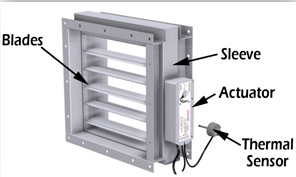
Figure 1: Fire Damper
2. Firestopping for Non-Dampered Ducts
Another fire blocking method is using materials meant for this purpose around duct openings. In cases below, you have to fire block around the duct opening:
1.Ducts Without Dampers
Fire blocking is required for HVAC ducts that penetrate smoke and fire barriers when a smoke or fire damper is not present. In such cases, the duct penetration must be sealed with fire stop or smoke sealing materials.
2. Ducts with Improperly Installed Dampers
If you can see light coming through from the other side of the wall around a fire damper, it indicates a gap. While the damper should internally prevent fire passage, this gap allows the external movement of smoke, gas, and flames. The ideal solution is to remove and properly reinstall the damper. If this is impossible or the code requires you to install fire blocking, you may create a smoke stop in this gap, as long as certain conditions are met.
Fire Blocking Materials
The materials used for fire blocking HVAC ducts should meet local code standards and be fire-resistant. Some common fire blocking materials include:
- Mineral Wool: A non-combustible material for fireproofing and thermal insulation.
- Fire-Rated Caulk or Sealant: We apply these materials around ductwork where they penetrate walls, floors, and ceilings, expanding when exposed to heat to seal off fire and smoke passages.
- Fire-Resistant Foam: You can use this material to fill gaps around ducts and other openings. When exposed to heat, this foam expands to fill the gaps and prevent the spread of fire.
- Fire-Resistant Boards: These boards are good choices to create fire-blocking barriers around ducts in specific areas.
Fire Rated Ducts
Don’t confuse the concept of fire rated ducts with fire blocking HVAC duct openings.
Fire Blocking Around the Duct Opening: Focuses on sealing the gaps at the penetration points where the duct meets fire-rated barriers. This is essentially about closing off the spaces around the duct openings to prevent the passage of fire or smoke.
Fire Rated HVAC Ducts: This involves ensuring that the duct system itself can resist fire and prevent the spread of fire and smoke through the ductwork. It applies to the whole HVAC duct system, not just the openings.

Figure 2: Fire Rated HVAC Duct
Considerations for Firestopping Non-Dampered Duct Penetrations
1. General Requirements
- Packing Material: Materials like backer rod or mineral wool are often helpful to allow the firestop sealant to span large annular spaces.
- Sealant Installation: The firestop sealant must be installed to the proper depth mentioned by the manufacturer.
2. Specific Considerations for Different Duct Types
Unlike plastic or metallic pipes, rectangular ducts have flat spans that can deflect rapidly at certain temperatures, creating an immediate gap that even expanding (intumescent) sealants cannot quickly overcome. Therefore, flat spans must be braced to prevent this deflection.

Figure 3: How Expansion During a Fire Changes the Geometry – Round Vs. Rectangular Duct
- Rectangular and Square Ducts:
- Reinforcing Steel Angles: Reinforcing steel angles of a specific gauge must be anchored on all four sides of the duct to prevent deflection.
- Installation: This bracing is necessary on both sides of the wall.
- Anchoring Principle: It is critical that these angles are anchored only to the duct and not to the wall. Anchoring them to the wall would restrict the duct’s ability to move freely during expansion and contraction, disregarding industry guidelines.
- Round and Spiral Ducts:
- Since these ducts lack flat sides and cannot deflect, reinforcing angles are unnecessary.
- Flat Oval Ducts:
- These ducts possess two flat sides, both of which must be braced with an angle.

Figure 4: Ducts with and without Reinforcing Angles
3. Ducts with External Insulation
When a duct has external combustible fiberglass insulation, you may require a different approach:
- Intumescent Wrap Strip: A layer of intumescent wrap strip must be inserted into the annular space and held firmly in place with two layers of foil tape.
- Intumescent Sealant: A bead of intumescent sealant is then installed to complete the seal. In this specific scenario, reinforcing angles are unnecessary. As fire burns away the fiberglass on the hot side, the wrap strip expands inward, sufficiently preventing the blanket on the cold side from burning. The combination of the sealant, wrap strip, and protected insulation allows this system to pass without steel angles, despite deflection.
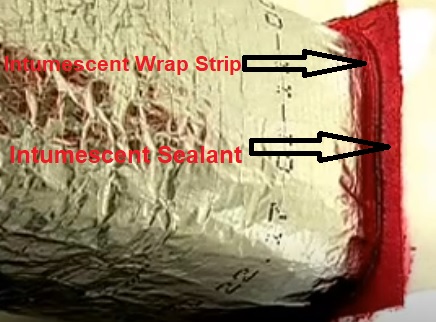
Figure 5: HVAC Duct with External Insulation and Intumescent Wrap Strip and Sealant
Addressing Gaps Around Fire Dampers
If an external smoke seal is considered for a gap around an improperly installed fire damper, the following strict conditions must be observed:
- Manufacturer Authorization: Written authorization from the damper manufacturer is mandatory to install an external smoke seal, ensuring the damper warranty is not voided.
- Non-Intumescent Sealant: You should make the external seal with a non-intumescent fire stop sealant. Intumescent sealant, when heated, could expand inwards, potentially preventing the damper’s closure and further compromising compartmentation.
- Sealant Flexibility: Due to duct expansion and contraction, the sealant must be highly flexible, such as fire stop silicone or a smoke barrier sealant.
Conclusion
Installing ductwork is one of the most challenging tasks in any construction project. With fire-related accidents on the rise, teaching homeowners how to protect their homes from fire has never been more important. HVAC ducts, while essential for heating and cooling, can unfortunately act as pathways for smoke and flames during a fire.
The first step is to use fire-rated ducts, and just as important, properly fire blocking HVAC duct openings. At Matrix Construction, your safety is our top priority. We want your home to be a secure, comfortable place where you and your family can live and thrive without worry.
Looking for reliable construction or renovation services in Philadelphia or South Jersey? Contact us today for a FREE Consultation!





![Ductless Mini Splits for Philadelphia Row Homes [2025 Guide]](https://matrixgc.com/wp-content/uploads/2025/07/Ductless-Mini-Splits-for-Philadelphia-Row-Homes-400x250.jpg)
0 Comments